


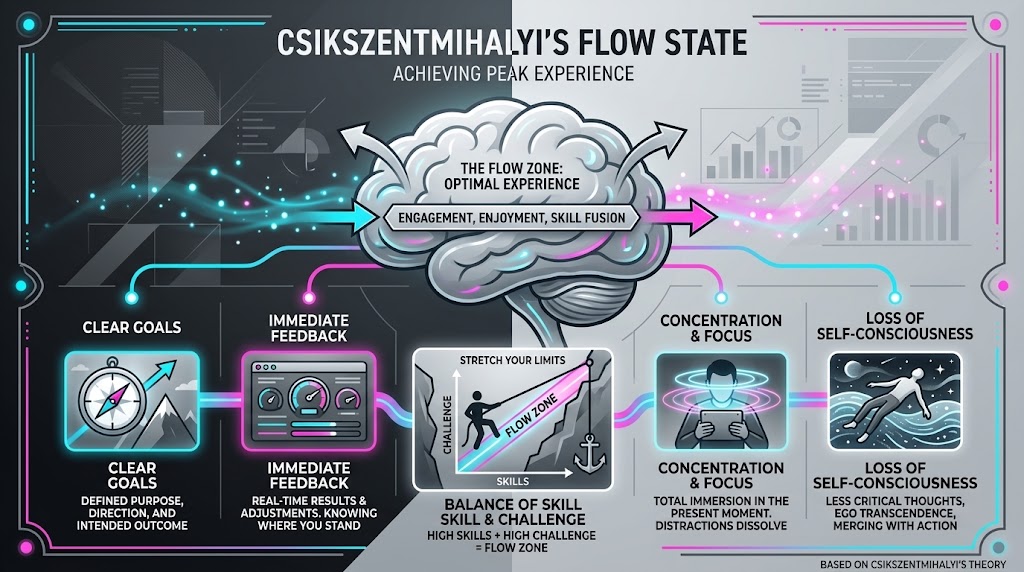
You look up from the book and it’s dark outside. You meant to play one round and it’s been four. You were stuck on a problem, and somewhere in the middle of it the room, the chair, your own name — all of it quietly stopped existing.
Nothing mystical happened. What happened has a name, six measurable conditions, and a growing pile of game design built directly on top of it.
The state everyone recognizes and almost nobody can produce on purpose
Ask people to describe their best moments and most of them will describe effort, not rest. The climber halfway up a wall. The surgeon four hours into an operation. The painter who forgot lunch. Nobody in that group was relaxing.
That’s the finding that started all of this. The psychologist Mihaly Csikszentmihalyi spent decades interviewing people who got so absorbed in what they were doing that they forgot to eat — painters, rock climbers, surgeons, chess players — and kept hearing the same description in different vocabularies. Total involvement. Effort that didn’t feel like effort. Some of them said it felt like being carried along by a current.
So he named the state after what they told him: flow. In 1990 he published Flow: The Psychology of Optimal Experience and made the case that our best moments are not the passive, receptive, comfortable ones. They arrive when body or mind is stretched to its limit, voluntarily, on something hard and worth doing.
Viktor Frankl had circled the same idea from a much darker direction: what a person needs isn’t a life without tension, but a goal worth straining toward. Flow is what that straining feels like from the inside when the conditions are right.
And “when the conditions are right” is the whole design problem. Because flow isn’t a mood you can request. You can’t decide to have it. You can only build the conditions that let it happen — which is exactly what a well-designed game does, on purpose, several times an hour.
The six conditions — and how a game manufactures each one
Csikszentmihalyi's list reads like a spec sheet. That's not an accident of my reading; it's why designers took it.
- A challenge that requires skill Optimal experience clusters inside goal-directed, rule-bound activities that demand real attention and can't be done without the right skills. He's specific that neither the activity nor the skill has to be physical — a chess position qualifies, so does a spreadsheet. What never qualifies is something you can already do on autopilot. Games solve this by making the challenge itself the content, then raising it as you improve.
- The merging of action and awareness People get so involved that the activity becomes spontaneous, almost automatic; they stop feeling separate from what they're doing. In a game, this is the moment the controller disappears from your hands. It's also why input lag and clumsy control mapping aren't cosmetic problems — they put the interface back between the player and the world.
- Clear goals and immediate feedback Full participation is possible, Csikszentmihalyi argues, because in these activities the goal is obvious and the feedback is instant. Games are structurally better at this than almost any other medium. A Goomba walks at you, you jump, you get a sound, a squash, a coin. Nobody read a manual. The feedback was the lesson.
- The paradox of control Enjoyable experiences involve a sense of control — more precisely, the absence of the worry about losing it that follows us through ordinary life. What people actually enjoy isn't being safe; it's exercising control in a difficult situation with a genuinely uncertain outcome. Which is the entire Souls-game bargain. Remove the possibility of failing and you remove the meaning of not failing.
- The transformation of time In flow, time stops behaving: a second stretches, an hour collapses into what felt like ten minutes. This is the condition players report most often and designers plan for least explicitly.
- The loss of self-consciousness Attention is so completely spent on the activity that there's nothing left over for monitoring yourself. He's careful here — it isn't a loss of self, and certainly not of consciousness, only a loss of awareness of the self. In a game, that's the line between playing a character and being one.
One warning from the same book, written in 1990 and aimed straight at every leaderboard shipped since: competition is enjoyable while it's a means of sharpening your skills, and stops being fun the moment it becomes the point.
The channel between boredom and anxiety
Put skill on one axis and challenge on the other. Too much challenge for your current skill produces anxiety; too little produces boredom. Flow lives in the narrow diagonal between them. And since skill rises while you play, the challenge has to rise with it — a flat difficulty curve is a promise to bore someone eventually.
Studios didn’t just borrow the metaphor. They wrote it into the code.
In 2006 a USC graduate student named Jenova Chen built his master’s thesis around this exact problem and shipped a Flash game called flOw to prove it. You drift through the deep as a microorganism while the game quietly reads how you’re doing and adjusts, so players of very different skill levels each end up inside their own channel. It hit six figures of downloads in two weeks, became a PlayStation title, and Chen went on to found thatgamecompany and make Journey.
Left 4 Dead (2008) does it with tension instead of difficulty. An “AI Director” watches the group and places enemies and supplies in response — quiet when you’re wrecked, a horde when you’ve been comfortable too long. Nobody scripted the scares. The system keeps four people inside the channel at once.
Then there’s the version I find most interesting, because it hands the dial to the player. Celeste (2018) ships an Assist Mode that lets you slow the game down, add dashes, or turn on invincibility, with a screen that says plainly this is a legitimate way to play. Hades has God Mode: 20% less damage the moment you switch it on, plus 2% more for every death, up to 80%. The game gets gentler exactly when you’re failing most, and never locks you out of the story. Both are flow theory taken seriously — the channel isn’t in the same place for every person, so let them find their own.
Exhibit: optimal experience is a specification, not a vibe
"Immersive" isn't a design goal. It's a description of a result, and you can't build toward a result. The six conditions give you variables you can actually work with.
- Is the challenge matched to this person's current skill — and does it scale as they get better?
- Are the goals legible without instructions?
- Is feedback immediate and unambiguous?
- Can they exercise real control over an outcome that's genuinely uncertain?
- Is anything pulling attention back to the self — a loading state, a permission prompt, a mis-mapped button, a form field that rejects the phone number you just typed?
That list works far outside games. It's the same reason good onboarding feels effortless, why a well-made tool disappears while you use it, and why some interfaces leave you tired after ten minutes.
So: what’s the last thing that took an hour off your clock without asking? A book, a boss fight, a bug you couldn’t stop chasing? Look at the six conditions and you’ll usually spot which one did it.
Museum of UX is an ongoing series on the theory and history behind the things we use.
Admission · Museum of UX
Enjoyed this visit?
Get the next UX exhibit, case study or design lesson delivered directly to your inbox.
No noise. One thoughtful UX email at a time.
Lifetime pass