


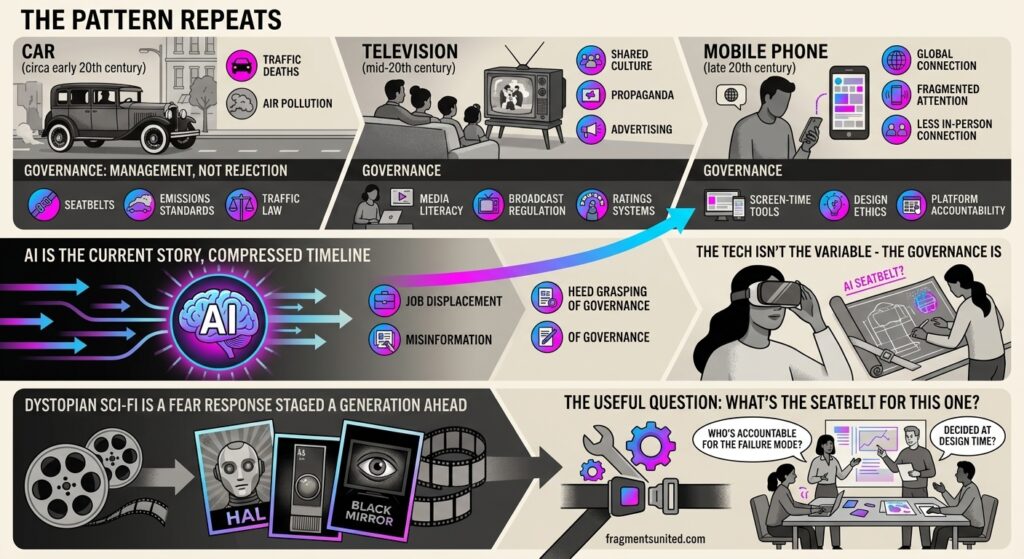
Before there was fear of AI, there was fear of the car. Before the car, the train — early 19th-century doctors seriously worried that traveling at 30 mph would damage the human body. Every major technology arrives with the same two-part bill: real, sometimes serious harm, and a wave of public anxiety that’s usually aimed at the wrong target.
The pattern repeats
Cars gave people unprecedented freedom of movement and reshaped entire economies — and also brought traffic deaths and air pollution at a scale no one had designed for. The fix wasn’t banning cars; it was seatbelts, crash testing, emissions standards, traffic law. Decades of management, not rejection.
Television put the whole world in the living room and created a shared culture at a scale radio never managed — and also enabled propaganda, advertising-driven manipulation, and, yes, people parked on the sofa for hours. The response was media literacy, broadcast regulation, ratings systems — imperfect, ongoing, still argued about.
Mobile phones connected billions of people to information and each other instantly — and also fragmented attention and, for some, replaced in-person connection. That management layer is still being built: screen-time tools, design ethics debates, platform accountability.
AI is the current version of the same story, compressed into a much shorter timeline.
The tech isn’t the variable — the governance is
In every case, the thing that actually got remembered wasn’t “the technology was good” or “the technology was bad.” It was whether society built the seatbelt fast enough. Pollution didn’t get solved by nostalgia for a car-free world; it got solved (partially, unevenly) by catalytic converters and regulation. The technology stayed. The management around it changed.
This is where it connects back to the film lens this series keeps returning to: dystopian sci-fi is usually a fear response happening in real time, staged a generation ahead. 2001‘s HAL is a 1968 anxiety about automation outpacing oversight. Black Mirror is anxiety about platforms outpacing regulation, told one episode at a time. These films aren’t really predictions — they’re the public’s seatbelt-lag made visible, dramatized before the actual policy catches up.
Which means the useful question a design or product team can ask isn’t “is this technology good or bad,” it’s “what’s the seatbelt for this one, and who’s building it — us, or someone downstream, later, after the damage is counted?”
That’s arguably still a UX question, just at the systems level instead of the screen level: who’s accountable for the failure mode, and was that decided at design time or left for someone else to clean up.
Worth pairing with
- 2001: A Space Odyssey — automation outrunning oversight, told at the dawn of computing anxiety
- Her — the quieter cost of frictionless connection, not the dramatic one
- Don’t Look Up — satire about the gap between danger and management, not the danger itself
- Wall-E — consumer tech and environmental cost taken to their logical endpoint
- Back to the Future Part II — for contrast, the rare case where the management layer looks like it worked
Admission · Museum of UX
Enjoyed this visit?
Get the next UX exhibit, case study or design lesson delivered directly to your inbox.
No noise. One thoughtful UX email at a time.
Lifetime pass