



How many links did you click today? Twenty? Two hundred?
You probably didn’t count — clicking a link feels as natural as opening a door. But somebody had to invent it. In this post I want to walk you through the surprisingly human story of how the link, the Internet and the Web came to be.
Spoiler: it took a war, a dreamer, and one very frustrated physicist.
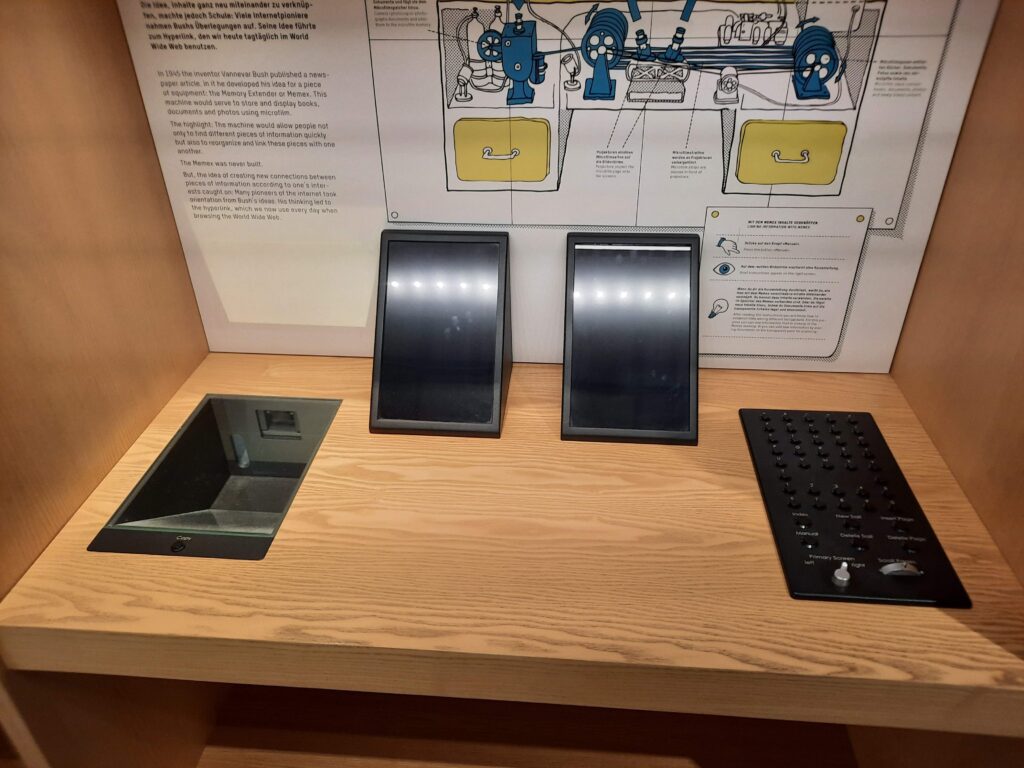
Memex reconstruction photo
Credit: Bunyk, CC BY 4.0, via Wikimedia Commons
1945: Vannevar Bush imagines the Memex
The story starts in 1945 — the same summer as Hiroshima and Nagasaki. American engineer Vannevar Bush published an essay in The Atlantic called “As We May Think,” where he described a hypothetical machine he named the Memex — a mix of “memory” and “index.”
The Memex was a desk with screens, in which a person could store all their books, records and letters — and connect any two documents, so that opening one could lead you to the other. Bush called those connections “trails.” Today we call them links.
His motivation was very much of its time: he had just watched science produce the atomic bomb, and he wanted it to produce something better — a kind of collective memory, a machine that would turn the explosion of information into an explosion of knowledge.
The Memex was never built. But the idea stuck.
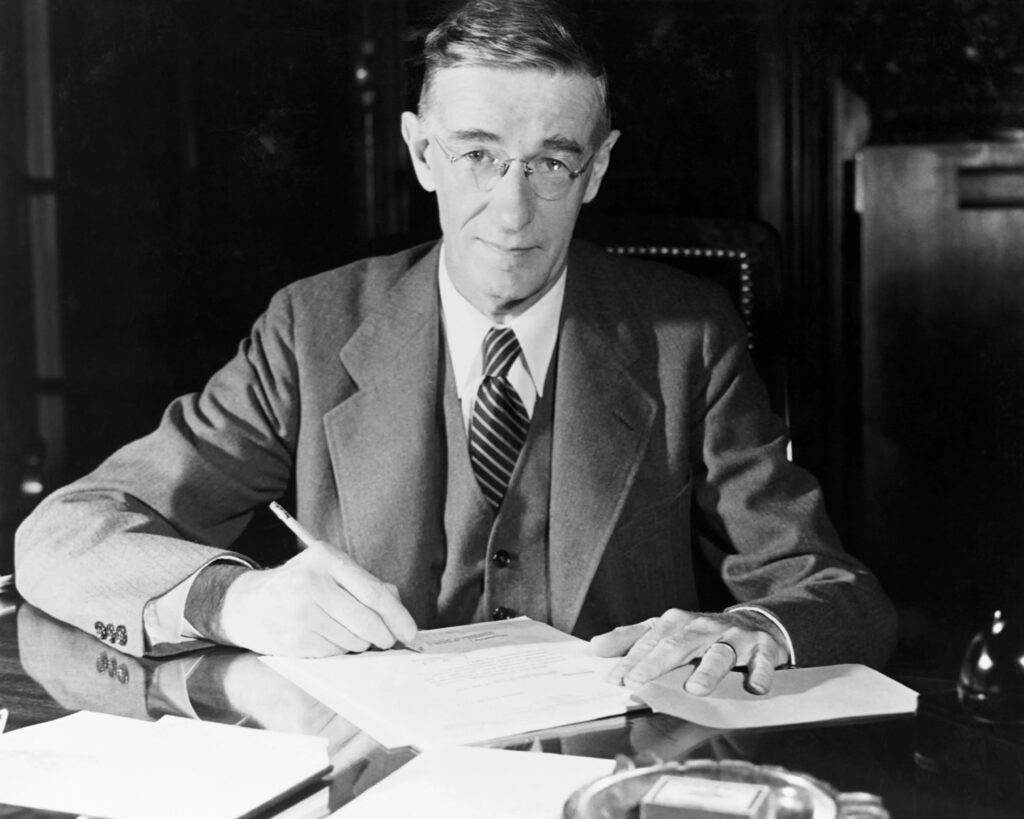
Vannevar Bush Credit: OEM Defense (Office for Emergency Management, U.S. Federal Government), Public domain, via Wikimedia Commons
1965: Ted Nelson gives it a name — hypertext
Twenty years later, Ted Nelson read Bush’s essay and gave the idea its name: hypertext — text that doesn’t have to be read in a straight line, text with exits. His own project, Xanadu, tried to link all of literature into one giant connected document. It was never finished — but the word, and the concept, spread everywhere.
And in 1968, Douglas Engelbart showed the first working clickable link live on stage — in the same demo where he introduced the computer mouse. The audience applauded… and then mostly forgot about it for two decades.
1969–1983: The Internet — great plumbing, terrible UX
Meanwhile, engineers were solving a different problem: connecting computers. ARPANET linked its first machines in 1969, and by 1983 the TCP/IP protocols turned scattered networks into the Internet — a global system for moving data between computers.
But here’s the thing: the Internet connected machines, not knowledge. To get a document, you had to know which computer had it, how to log in, and which commands that specific machine understood. The information was connected — the experience was a nightmare. In other words: a UX problem.
1989: Tim Berners-Lee connects the dots
Enter Tim Berners-Lee, a British physicist at CERN — at that point the largest Internet node in Europe, and a place drowning in incompatible documentation systems.
His genius move wasn’t inventing something new. It was combining things that already existed: he took the hypertext idea, connected it to the Internet’s TCP and DNS — and, as he put it himself, “ta-da!” — the World Wide Web. He even described creating the Web as an act of desperation: the technologies were all there, he just had to put them together.
In 1990, the first web server went live on a NeXT computer in his office — with a hand-written sticker on it warning people not to switch it off.
I love this part of the story, because it’s a lesson for every designer: the Web wasn’t a breakthrough in technology. It was a breakthrough in thinking — imagining all those separate documentation systems as parts of one bigger whole.
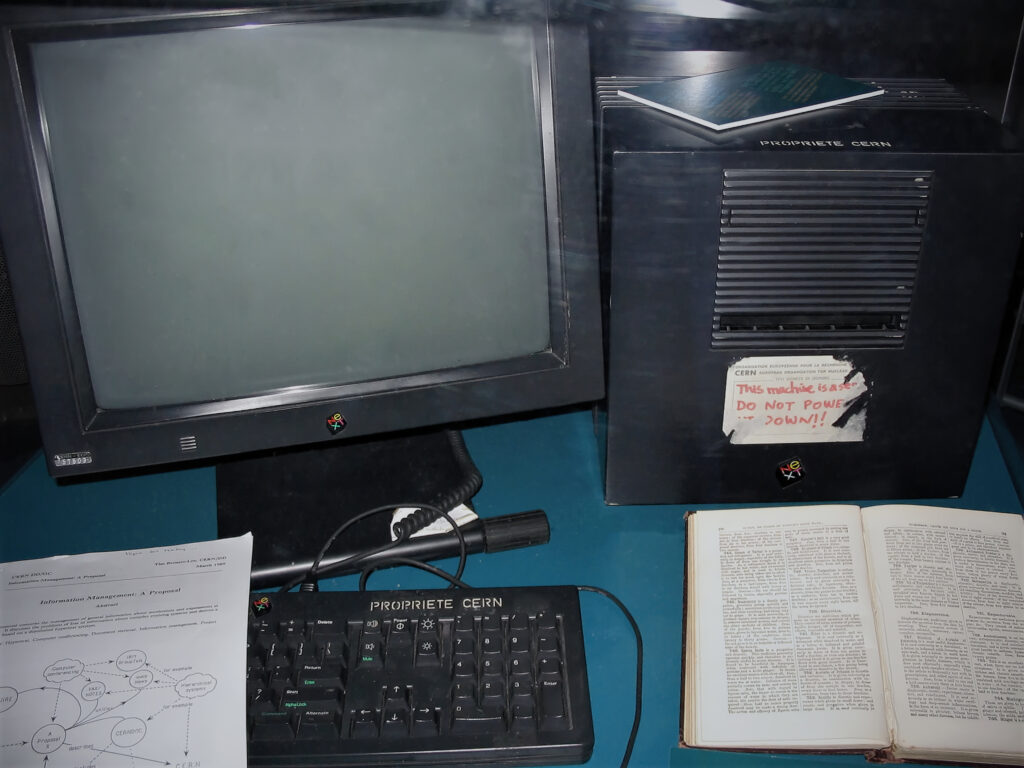
First Web Server Credit: Coolcaesar at the English-language Wikipedia, CC BY-SA 3.0, via Wikimedia Commons
The person history forgot: Robert Cailliau
Every origin story flattens someone. Robert Cailliau, a Belgian engineer at CERN, had proposed his own hypertext system already in 1987. He became Berners-Lee’s closest collaborator: he co-wrote the funding proposal, designed the original WWW logo, organized the first International World Wide Web Conference in 1994, and helped move the Web from CERN into the hands of the whole world in 1995. The two of them jointly received the ACM Software System Award.
If Berners-Lee built the Web, Cailliau made sure everyone was invited in.

First WWW logo Credit: RobertCailliau, CC BY-SA 4.0, via Wikimedia Commons
So — who invented the link?
Nobody, and everybody:
- Vannevar Bush dreamed it (1945)
- Ted Nelson named it (1965)
- Douglas Engelbart demonstrated it (1968)
- Engineers built the network underneath it (1969–1983)
- Tim Berners-Lee and Robert Cailliau put it all together and gave it to the world (1989–1995)
The link is more than technology — it’s an idea: that knowledge belongs together, and the shortest distance between two ideas should be one click. Every link you tapped today is, in a way, one of Bush’s trails.
Next time in the Interface History series: how the desktop metaphor was born — and why your computer still has a “trash can.”