

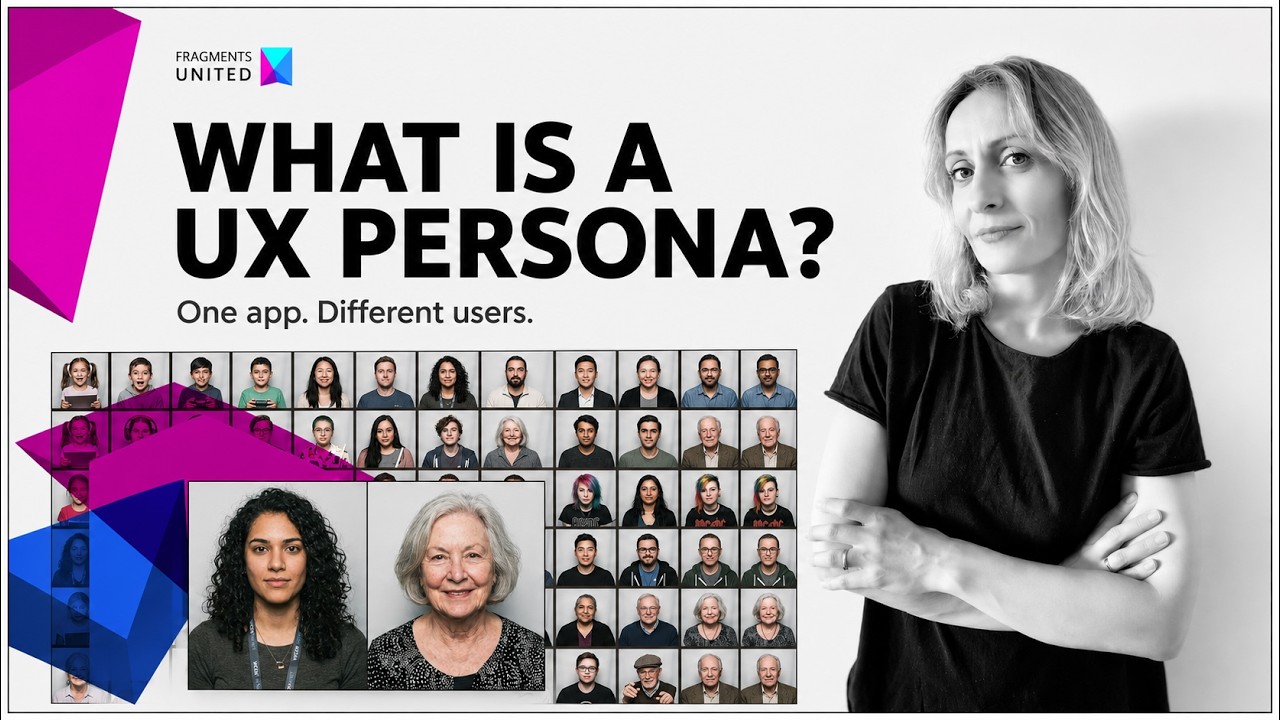
Who are you designing for? It sounds like the most basic question in product design, and yet it is the one most often skipped. In this post — and in the video above — I want to make the case for slowing down and truly getting to know your users, because that knowledge is what lets a product rise above the ocean of similar, generic apps.
Why niche beats generic
When we design for a specific niche, we can be more creative, not less. We can speak our users’ own language, shape the interface around their habits, and personalize the system so it responds to their actual needs. A product for “everyone” ends up resonating with no one.
To make this concrete, let’s take one familiar product category — a food delivery app — and look at it through the eyes of two very different people.
Two personas, one app category
Persona 01
Margaret, 72 — The Cautious Senior
Context. Lives alone, orders food occasionally, dietary limits due to age and medication — less grease, less fat.
Frustrations. Ordering feels complicated. She doesn’t trust apps with her credit card, loses her way in the checkout process, and can’t easily find what she’s looking for.
What the design must do. A radically simple ordering flow, large type, human-feeling communication — perhaps a voice-controlled assistant or a simple chatbot that helps her set up a profile and place an order.
Persona 02
Ana, 28 — The Energized Professional
Context. Works from home and from the office, possibly still studying. Lives on Instagram and Pinterest — photography, home décor, everything creative.
Motivations. Food is fuel and pleasure. She wants healthy meals that give her energy and better productivity — omega-3s for brain power, not just convenience.
What the design must do. A visually rich, creative app with nutrition advice, filtering she can adapt to her own needs, and flexible delivery times and services.
Same product category. Two completely different lists of problems to solve — and two completely different interfaces. That is the power of the persona: it turns “users” from an abstraction into a set of concrete demands, problems, and opportunities.
Test with your grandmother, not your best friend
Personas give us a hypothesis. The prototype is where we test it: does our vision of the product actually match what these people expect it to do for them?
Even if you can’t afford expensive testing platforms, you can — and should — put your prototype in front of the people who will actually use it. And here is the rule I always give my students and clients:
You don’t test the senior persona’s prototype with your best friend. You test it with your grandmother. You don’t test the young professional’s app with your boyfriend. You test it with your neighbour — the woman who works, and who actually needs healthy food delivered.
Only then do you see how your product really works.
Launch is a birth, not a finish line
For launch, we ship an MVP — a minimum viable product — with a roadmap of features for future enhancement. Because publishing a digital product is not the end of the story. I like to say the product is born at launch. Now it has to grow, develop, evolve — on one side adapting to changing technology and legal requirements, and on the other to changing user habits, demands and needs. A living product evolves along both of these axes at once.
From persona to prototype: try it yourself
Theory is easier to trust when you can touch it. Following the senior persona above, I designed a working prototype of a food ordering app built entirely around Margaret’s needs: voice commands, clear prompts, and large text for a simple, accessible ordering experience.
Live prototype
Senior Food Ordering App
A voice-first, large-type ordering flow designed for users who find standard delivery apps overwhelming.
In an upcoming post I’ll walk through the design decisions behind this prototype — the accessibility choices, the voice-first flow, and what testing revealed.
The point of all of this
Always come back to the user. What problem are we solving? How are we helping them? To empathize with people, we first have to know them — and that is not an easy task. But it is exactly what lifts a product above the sea of lookalikes. When a product responds to people and resonates with them, they will see it, they will find it, and — most importantly — they will start using it, like it, and make a friendship with it.
Build products people actually love to use.